
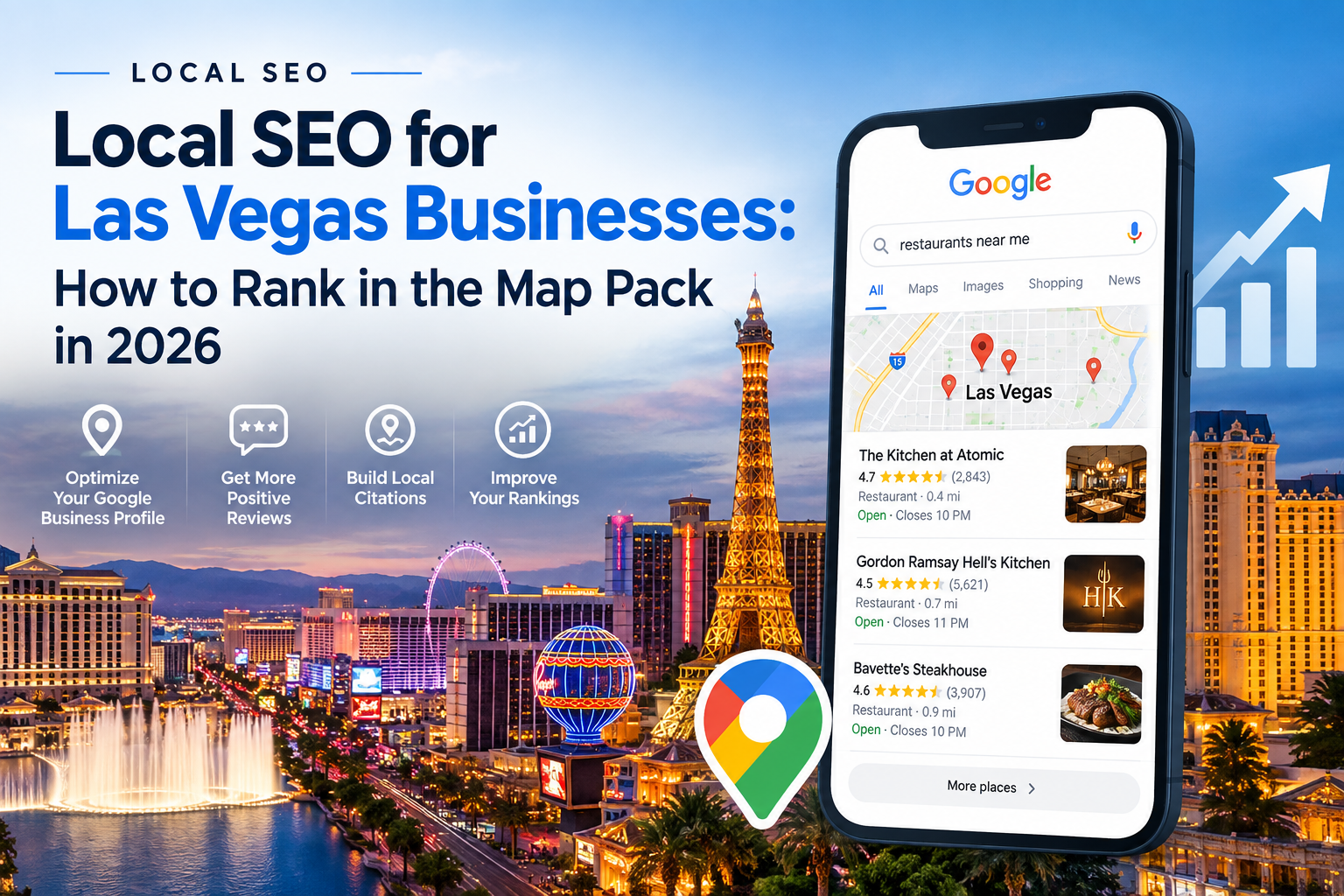
Quick answer: Local SEO is the process of making your business show up when Las Vegas customers search for what you sell, especially in Google’s map results. The biggest factors are a complete Google Business Profile, consistent business info across the web, real customer reviews, and a website that clearly says what you do and where you do it.
Let’s be real for a second. If someone in Henderson types “best plumber near me” at 9 PM with water on their kitchen floor, they aren’t scrolling to page three. They’re calling one of the first three businesses they see. Those three spots are called the map pack, and getting into them is one of the most valuable things a Las Vegas business can do online.
The good news is that local SEO isn’t magic. It’s a checklist, and most of your competitors are doing it badly.
What is local SEO, exactly?
Local SEO helps your business appear in searches with local intent: “roofer in Summerlin,” “dentist near me,” “tacos Las Vegas.” Google looks at three big things when it decides who to show:
- Relevance: Does your business match what the person searched for?
- Distance: How close are you to the searcher?
- Prominence: How well known and trusted are you, based on reviews, mentions, and your website?
You can’t change where your shop is located, but you have a lot of control over the other two.
Step 1: Fully build out your Google Business Profile
Your Google Business Profile (GBP) is the single most important local SEO asset you own, and it’s free. Here’s what to do:
- Pick the right primary category. This matters more than almost anything else. “Air conditioning contractor” and “HVAC contractor” are not the same thing.
- Add secondary categories for every service you actually offer.
- Fill out every field: hours, services, service areas, description, attributes, and the appointment link.
- Upload real photos regularly. Your team, your trucks, your storefront, finished jobs. Skip the stock photos.
- Post updates. Offers, projects, and news show Google you’re active.
Treat your profile like a mini website, because for many customers it’s the only page of yours they’ll ever see.
Step 2: Get your NAP consistent everywhere
NAP stands for Name, Address, Phone number. Google cross-checks these details across directories like Yelp, Bing, Apple Maps, the Better Business Bureau, and industry-specific sites. If you’re “Desert Sun Roofing LLC” in one place and “Desert Sun Roofers” in another, with two different phone numbers, you’re sending mixed signals.
Pick one exact format and use it everywhere. Then audit your listings and fix the mismatches.
Step 3: Earn reviews the right way
Reviews are a huge part of prominence, and they’re also what customers read before they call. A few ground rules:
- Ask every happy customer. The easiest time is right after you’ve solved their problem.
- Make it easy. Send a direct review link by text or email.
- Respond to every review, good and bad. Keep replies human, and mention the service or neighborhood naturally when it fits.
- Never buy or fake reviews. Google is good at spotting it, and it can get your listing suspended.
Step 4: Make your website say where you work
Your website should back up what your profile claims. That means:
- A clear homepage that states what you do and that you serve Las Vegas and nearby areas.
- Separate pages for each core service (not one giant “Services” page).
- Location or service-area pages for places like Henderson, North Las Vegas, Summerlin, and Enterprise, but only if you have something genuinely useful to say for each. Copy-pasted pages with the city name swapped out don’t help you.
- Your NAP in the footer, an embedded map, and a fast, mobile-friendly design.
Most Las Vegas searches happen on a phone, so if your site is slow or clunky on mobile, you’re losing customers before they read a word.
Step 5: Add structured data (schema)
Schema markup is behind-the-scenes code that tells search engines and AI tools exactly what your business is: your name, services, hours, service area, and reviews. LocalBusiness schema is a great starting point. It helps search engines understand you, and it supports how AI tools summarize and cite local businesses.
Common local SEO mistakes we see in Las Vegas
- Using a P.O. box or fake address for a profile (Google can suspend for this).
- Stuffing keywords into your business name.
- Ignoring reviews for months.
- Having a website with no city or service information on it.
- Setting up a profile once and never touching it again.
A simple 30-day starter plan
Week 1: Claim and complete your Google Business Profile. Week 2: Audit and fix your listings. Week 3: Build a review-request habit. Week 4: Tighten up your website’s service pages.
That alone will put you ahead of a surprising number of local competitors.
Frequently Asked Questions
How long does local SEO take to work?
Small improvements, like a cleaned-up profile, can show results in weeks. Competitive searches usually take a few months of steady effort.
Do I need a website if I have a Google Business Profile?
Yes. Your profile gets you seen, but your website builds trust and gives Google more information to rank you.
How many reviews do I need?
There’s no magic number. Aim to be consistently earning fresh, genuine reviews and to match or beat the top competitors in your category.
Is local SEO worth it for a small business?
For most businesses serving a specific area, it’s one of the most cost-effective ways to get leads, because you’re reaching people already searching for what you sell.
Want a second set of eyes?
If you’d like someone to look at your profile and website and tell you what’s holding you back, that’s what we do. Reach out to Your Vegas Marketer for a free, no-pressure chat.